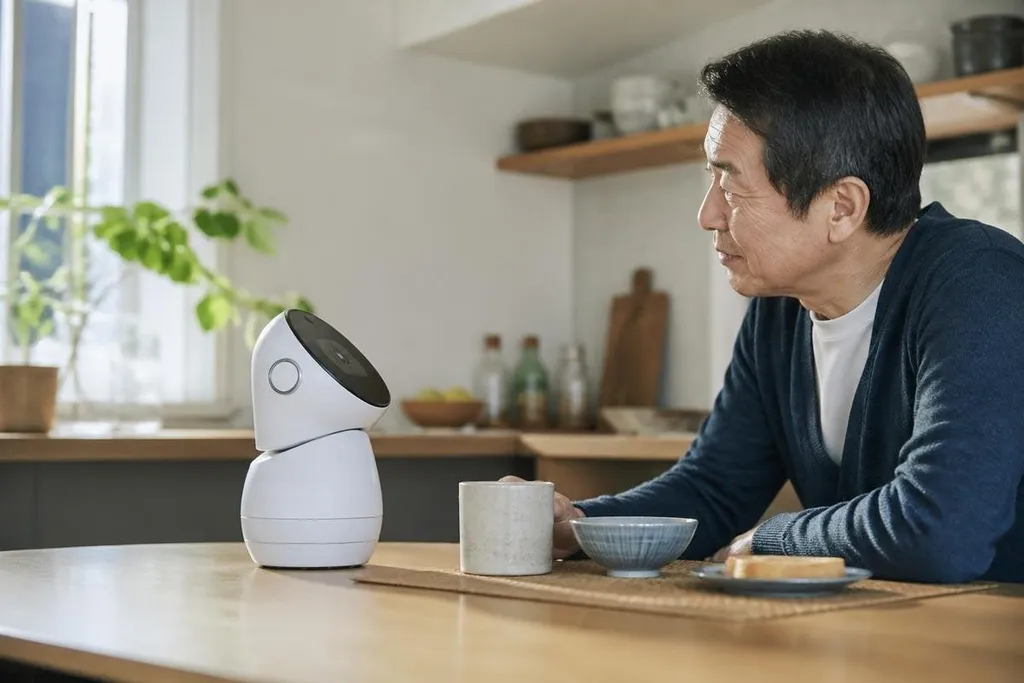
A companion robot may spend most of its time asking questions, reminding someone about a task, or reacting to speech. Those small exchanges can change how a person spends time alone, speaks with family, and decides when human help is needed.
The effect depends less on a robot sounding human than on the routine built around it. A machine that checks in each morning creates a different relationship from one used only for games or remote care.
- Daily prompts can turn care into a regular habit.
- Voice and movement can make a machine feel socially present.
- Privacy, dependence, and missed human contact remain open concerns.
The robot becomes part of a routine
A companion robot works through repeated contact. It may greet a person, ask about a planned activity, or remind them to take a break. The action is basic, but the timing gives it social meaning.
That routine can help someone mark the start of a day or keep contact with a family member. A robot linked to a video call could also make it easier for relatives to check in without waiting for a formal appointment.
The machine does not need a human face to affect the room. A moving head, a name spoken aloud, or a response that refers to an earlier exchange can make the interaction feel directed at one person rather than sent into empty space.
Social contact changes shape
Companion robots can sit between a tool and a social partner. They answer on demand, yet they do not bring the judgment, memory, or care of a person who knows the user well.
That middle position matters. Someone may speak to a robot because it is available at 9 p.m., when a family member is busy. The exchange can ease a quiet moment, but it can also remove a reason to call a person if the robot meets too many needs on its own.
The design choice is visible in the robot’s replies. A system that keeps asking for more conversation may create longer sessions. One that points the user toward a relative, carer, or friend keeps human contact in the loop.
Care needs clear limits
A companion robot can remind, prompt, and pass information to another person. It should not be treated as a doctor, counsellor, or family member unless a qualified service has set strict rules for that use.
The main risk is misplaced trust. A user may assume the robot remembers everything, understands emotion, or can spot a health problem. Those assumptions can lead to missed calls, poor decisions, or private information stored in the wrong place.
For a buyer weighing a companion robot, companion robot reports from Robot24.com can tie claims about memory, emotion, and care support to named machines, test dates, and stated limits. Those details set up the next section on what companies need to prove.
What companies need to prove
A useful companion robot needs more than a pleasant voice. It must work through the daily situations that shape trust.
That includes speech in a noisy room, clear alerts when the robot fails, and controls that let a person pause or delete stored data. The robot also needs a safe way to hand a problem to a human instead of continuing the conversation with a weak guess.
The hard part is measuring the social result. A longer conversation is not automatically a better one. A successful system may be the one that helps a person contact a friend, finish a care task, or feel ready to leave the house.
A practical buying checklist
Before choosing a companion robot for a home or care setting, check these points:
- Name the task: Write down the one daily problem the robot must help with.
- Check the handoff: Find out how it contacts a family member, carer, or emergency service.
- Review stored data: Ask what audio, video, and messages remain on the robot or in the cloud.
- Test failure notices: Confirm that a person can tell when the robot has lost power, network access, or speech recognition.
- Set a human plan: Pick a real person who will review the robot’s alerts and change its settings.
I’d choose a companion robot for a defined routine, not as a replacement for regular human contact. The useful test is simple: after the robot enters the home, does the person have more chances to reach people, or fewer?